Google Possum: Everything You Need to Know for Local SEO
When your company relies on local clients, it is important to know about the local search updates of Google. Google Possum is one of the most significant changes that have altered local search rankings. This update of the algorithm was introduced in 2016 and had a considerable impact on the way businesses are displayed in the local search results and Google Maps.
Google Possum was the first major update to Google that targeted local search as opposed to traditional organic search. Its main objective was to give the users more accurate, diverse, and location-based search results. This meant that businesses that were within the city limits but not in the city, companies with the same address and businesses with similar categories saw their local ranking change significantly.
In this guide, you’ll learn what Google Possum is, how it works, and what you can do to improve your local SEO performance.
What Is Google Possum?
Google Possum is a local search algorithm update that aims at enhancing the relevance and variety of local search results. Prior to this update, companies not within the official boundaries of a city tended to be hard to find in a search of that city. Google Possum changed that by placing greater importance on the searcher’s location and the overall relevance of a business.
The update also brought more powerful filtering techniques. Rather than completely eliminating duplicate listings, Google started to filter businesses that seemed too close to each other. This was particularly evident among businesses that were located in the same building, address or ownership.
Google Possum primarily impacted the Local Pack, Google Maps, and location-based search queries, instead of altering the ranking of websites in organic search.
How Google Possum Changed Local SEO
Google Possum introduced a number of significant changes, which still affect local SEO.
Among the largest changes was a better location sensitivity. The search results have become different in accordance with the place the user is searching. Even a couple of miles can have varying local outcomes since Google attempts to show businesses nearest to the location of the searcher.
The other significant transformation was that of businesses that were not within the city boundaries. Prior to Possum, these businesses would not be able to rank near cities. Following the update, several could now be included in searches provided they were highly relevant and geographically near the user.
Address-based filtering was also introduced by Google. Companies that are located in the same office block or have the same address might discover that there is only one listing to some searches. This filtering is aimed at decreasing duplicates or almost similar listings and enhancing the diversity of results.
Also, the variations of key words gained significance. Minor variations in search terms, like dentist near me and family dentist, can yield varying local search results. This provides the businesses with a greater chance to rank on a broader set of relevant keywords.
The Biggest Ranking Factors After Google Possum
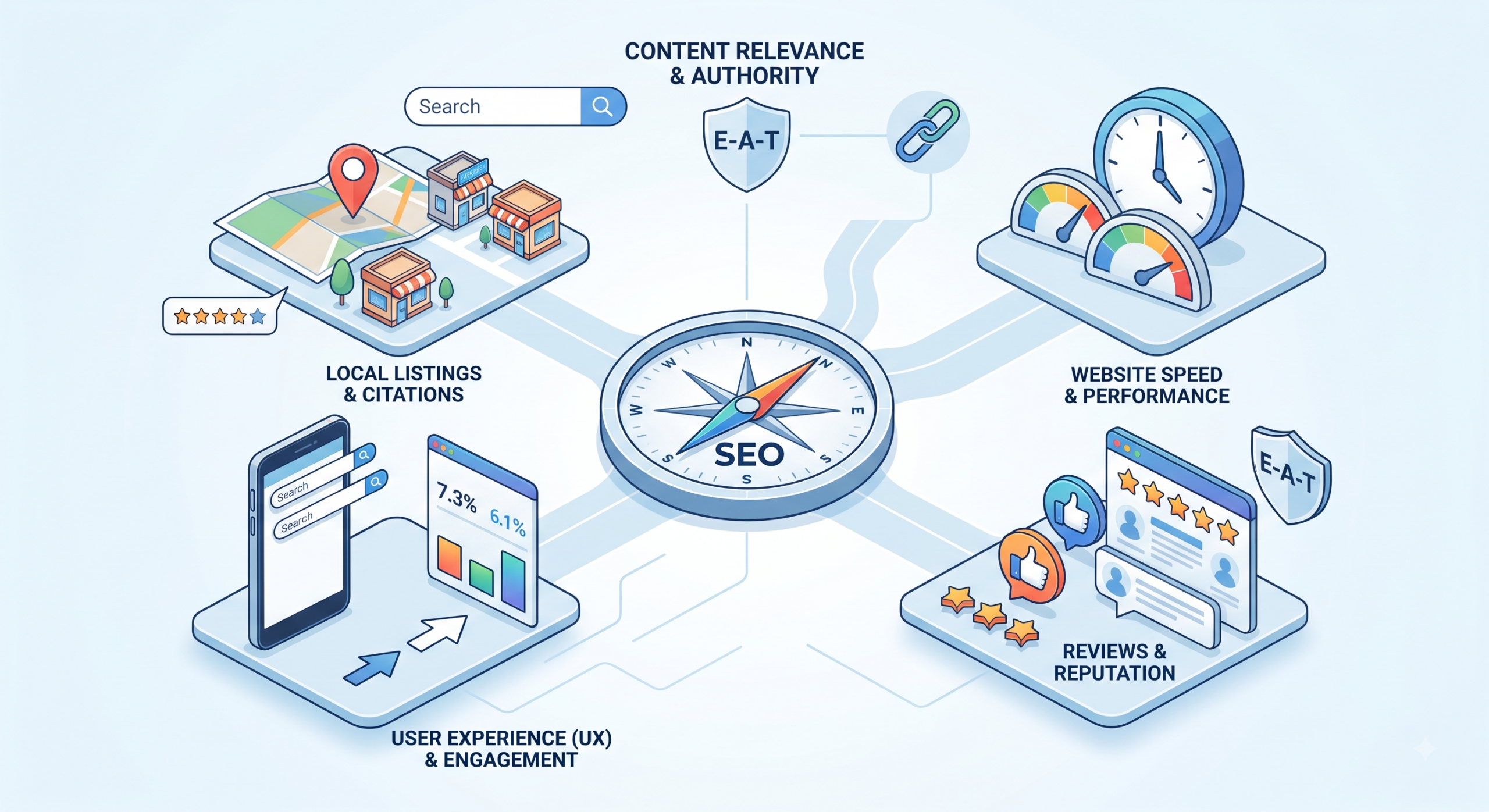
Despite the fact that Google Possum altered the functionality of local search, the fundamentals of local SEO have stayed unchanged. Companies that are quality-driven, relevant, and trusted are still doing well.
Your Google Business Profile plays a major role in local rankings. Having your business information up-to-date and full makes Google know what services you offer and where you are. Always keep your business name, address, phone number, web site, categories, business hours and photos updated.
Another important ranking factor is customer reviews. Good reviews enhance credibility besides indicating trustworthiness to Google. Reviews can be responded to, which demonstrates that you are interested and can increase your reputation in the area.
It is also important that there is consistency in online directories. Your business data ought to be the same everywhere it is on the internet. Mixed contact information may mislead search engines and decrease your local presence.
Good local backlinks are also a factor to better rankings. References to credible local organizations, news sites, chambers of commerce, and industry-related sites are useful in building authority in your geographic region.
Lastly, you can develop location-specific content on your site, which will enable Google to learn more about the regions you serve and services you provide.
Common Local SEO Challenges After the Possum Update

Google Possum was released and many businesses observed unforeseen ranking changes. Filtering instead of penalties is one of the problems. When your business does not appear in the Local Pack when you search on some searches, but it is on Google Maps, it might just be filtered since another similar business has the same address or category.
This is a challenge that is usually faced by businesses that are based on a shared office space. Several law firms, medical practices, or marketing agencies can be found in the same building and compete with each other, and Google shows only the listing it deems as the most relevant.
The other issue is the changing rankings. Because Google is more concerned with the location of the searcher, your ranking may change based on the location where the search is done. This complicates the local rank tracking as compared to the traditional SEO.
Businesses must also not have more than one listing of the same location in an effort to gain visibility. This strategy is not very effective and can be detrimental because Google tends to filter or delete duplicate listings.
Best Practices to Improve Local SEO After Google Possum
Adapting to Google Possum requires a well-rounded local SEO strategy. Begin by updating your Google Business Profile with all the information. Choose the most appropriate business categories, primary and secondary, post high-quality pictures, and update regularly.
Naturally use location-based keywords on your site. Use city names, neighborhoods and areas of service where needed, but do not overstuff with key words. Properly written service pages and local landing pages make search engines know about your geographic relevance.
Ask your satisfied customers to post authentic reviews on your Google Business Profile. Regular positive feedback reinforces your online reputation and aids in improved local rankings.
Create citations on reputable local directories and make sure that the information about your business is the same on all platforms. Local search can be impacted by even minor discrepancies in your name, address, or phone number.
Improve your website’s technical SEO by increasing page speed, making your site mobile-friendly, and using secure HTTPS connections. As numerous local searches occur on smartphones, a quick and responsive site offers a more positive user experience and helps to achieve higher rankings.
Finally, monitor your local search performance regularly. Analyze which keywords generate visibility, identify ranking fluctuations, and continue refining your local SEO strategy based on performance data.